
Bharat Tex 2026: Weaving Modi’s 5F Vision – Shri Pabitra Margherita, Union Minister of State for Textiles
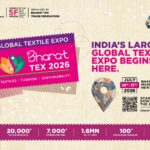
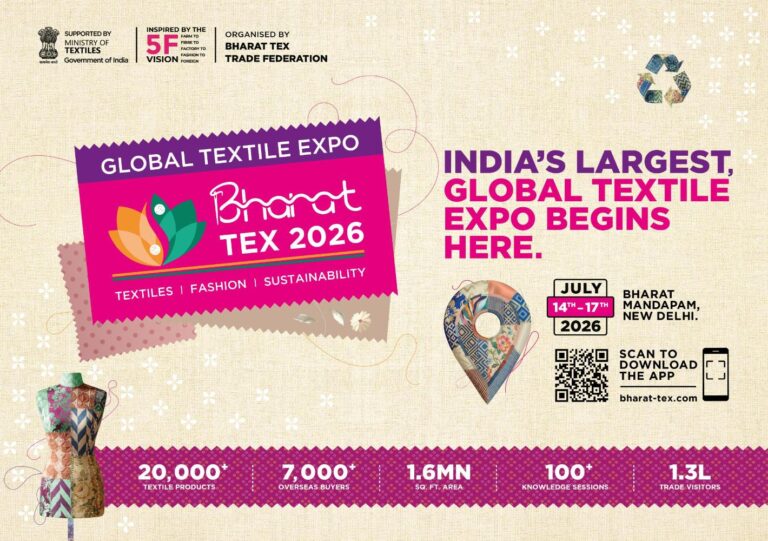
From the ethereal warmth of a Kashmiri Pashmina to the majestic luster of Assam’s Muga silk, from the vibrant geometric patterns of a Rajasthani Bandhani to the timeless, structured elegance of Kanjeevaram silk, India’s geographic and cultural diversity is a living, breathing map drawn in thread. Today, this unparalleled civilizational canvas is assembled under a single, unified roof. As Bharat Tex 2026 opens its doors at the iconic Bharat Mandapam in New Delhi, running from July 14th to 17th, it brings the beautiful diversity of our nation into a single place.
Textiles are not merely a reflection of our heritage; they are an absolute bedrock of India’s macroeconomic architecture. The sector remains a monumental engine of growth and equity, contributing 2.3% to GDP, 13% to industrial production, and 8.6% to exports. As India’s second-largest employer after agriculture, it sustains over 100 million, strengthening rural communities and driving financial autonomy for millions of women nationwide.
To truly appreciate this economic powerhouse, one must experience Bharat Tex. It is India’s definitive, global-scale textile trade fair, designed to showcase our absolute manufacturing and creative dominance to the entire world. It acts as a comprehensive marketplace hosting domestic manufacturers, state pavilions, international exhibitors, and global buyers under a single roof, enabling high-value sourcing, corporate engagement, and brand showcasing at an unprecedented scale.
Reflecting on the journey of this grand initiative, I am reminded of the immense pride and clarity brought by the previous two editions of Bharat Tex. When Prime Minister Narendra Modi addressed the textile community during the last edition of Bharat Tex, he beautifully observed that the seed we planted is now rapidly growing into a banyan tree. He noted that this grand showcase not only celebrates our rich traditions but also highlights the immense possibilities of a developed India. The massive success of the first two editions, which attracted unprecedented international buyers and generated massive collaborative momentum, laid a formidable foundation. My personal experience during the Bharat Tex 2025 ,witnessing intensive government-to-government and business-to-government dialogues translated into tangible outcomes confirmed a highly positive outlook for the future and demonstrated growing global trust in India’s execution capabilities. This third edition takes that momentum significantly further, translating early potential into absolute industrial dominance.
The incredible scale of this year’s event represents a calculated industrial strategy. Spanning an immense footprint across dedicated exhibition halls at Bharat Mandapam, the exhibition presents India’s complete textile value chain including fibre, yarn, fabric, apparel and fashion, home textiles, technical textiles, and ancillary industries. Over 1,600 exhibitors are participating, bringing localized production strength directly onto the global platform to mirror Prime Minister Modi’s transformative 5F Vision: Farm to Fibre to Factory to Fashion to Foreign. By integrating the entire value chain into a single industrial continuum, the event showcases India’s self-reliant capacity to manage every manufacturing stage natively.
The global response to this proposition has been remarkable. This edition features international exhibitors from 14 countries including the United States, United Kingdom, Japan, Portugal, Spain, New Zealand, South Korea, South Africa, and Nepal, alongside strong institutional representation from the United Nations and the European Union. Ministerial delegations and high-level business representatives from several countries are participating to explore long-term partnerships. The exhibition is expected to draw over 7,000 buyers from over 110 registered countries and 1.3 lakh trade visitors over the four days, all engaging with more than 20,000 textile products on display. This commercial activity will be anchored by more than 3,500 curated business-to-business meetings, alongside dedicated State Investor Connect Sessions that provide individual Indian states a platform to pitch their distinct industrial infrastructure.
True industrial leadership requires a deep commitment to knowledge and future planning. Bharat Tex 2026 anchors this responsibility through the Global Textile Dialogue, which comprises over 100 curated sessions including panel discussions, roundtables, masterclasses, state sessions, awards pitch fests, and workshops. Led by more than 370 international and national CXOs, policymakers, and innovators, these curated tracks will focus on scaling Trade and Investment, advancing Technology and Innovation, and elevating Fashion and Craft. The event will also witness the signing and launch of several strategic agreements and sectoral reports across trade, investment, technology, and institutional collaboration.
A significant focus of these deliberations is dedicated to the critical pillar of Sustainability and Circularity. During the previous edition, the Prime Minister highlighted that the global fashion community is increasingly embracing the vision of ‘Fashion for Environment’ and that sustainability has always been an integral part of Bharat’s textile heritage. This edition of Bharat Tex turns global eco-challenges into a massive opportunity, showcasing how cutting-edge innovations evolve our traditional techniques to maximize resource efficiency and eliminate waste, directly benefiting our weavers and artisans. Under the pragmatic leadership of our Minister of Textiles, Shri Giriraj Singh Ji, the Ministry has actively accelerated these modernization and sustainable growth initiatives on the ground,
ensuring that our entire textile value chain is backed by robust modern technology, scalable policy frameworks, and robust market linkages.
The remarkable scale and confidence reflected through Bharat Tex are the direct outcome of a decade of sustained policy reforms under the leadership of Prime Minister Narendra Modi. Over the past 12 years, the Modi Government has strengthened every link of the textile value chain through transformative interventions. The Production Linked Incentive (PLI) Scheme for Textiles has attracted investment commitments of over ₹31,687 crore, catalyzing large-scale manufacturing in Man-Made Fibre apparel, fabrics, and technical textiles while generating massive employment. Simultaneously, seven PM MITRA Parks are being developed as integrated manufacturing ecosystems embodying the Prime Minister’s visionary 5F approach. Grassroots empowerment remains equally robust; through the National Handloom Development Programme, nearly ₹2,000 crore has been invested across 794 handloom clusters, providing upgraded looms to 1.17 lakh weavers and skill training to around 90,000 workers, while over ₹1,335 crore has been channeled into the handicrafts sector under the National Handicrafts Development Programme. Furthermore, over 1.5 lakh weavers have been onboarded onto the Government e-Marketplace (GeM), with the Weavers’ MUDRA Scheme providing collateral-free loans to nearly 3 lakh beneficiaries. By connecting our domestic manufacturers, artisans, and innovators directly with global markets, these comprehensive reforms have structurally prepared us for the massive global step-up we see on display this week.
As we look across the vibrant exhibition halls of Bharat Mandapam, our perspective extends far beyond the immediate horizon of this trade show. This event serves as a critical milestone along our Vision 2030 roadmap to scale India’s textile industry into a $350 billion global powerhouse, a trajectory aligned perfectly with the national goal of Viksit Bharat @ 2047. I invite everyone to join us over these next four days at Bharat Tex 2026 to witness the incredible strength of our workers, the brilliant innovations of our creators, and the future of global textiles, proudly designed, sustainably made, and integrated at scale in India.